

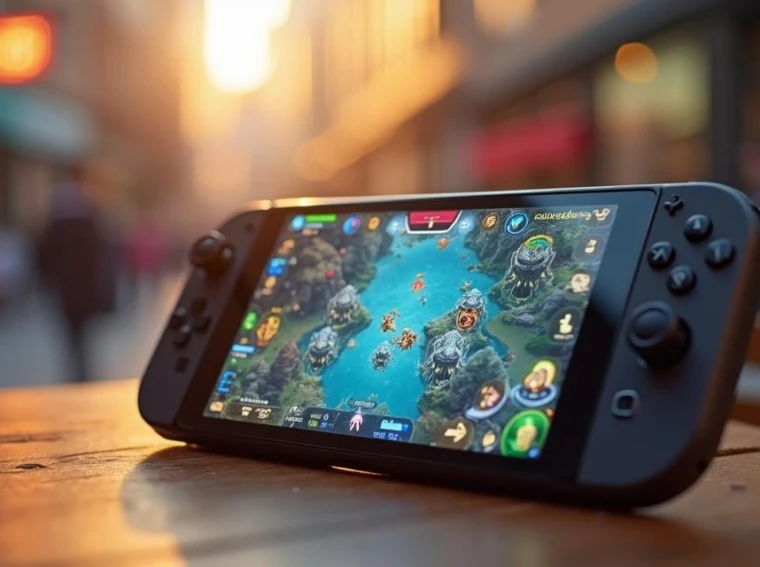
Anyone who has watched a friend boot up Honkai: Star Rail on the bus, then switch to a quick Marvel Snap match between subway stops, knows the centre of gravity in gaming has moved into a back pocket. Newzoo put the global games market at roughly 188.9 billion dollars in 2025, with mobile alone accounting for about 103 billion of that and holding a 55 percent share of total spend. On top of that, dedicated portable hardware has gone from a niche to a busy category: Valve shipped the original Steam Deck on 25 February 2022, ASUS answered with the ROG Ally on 13 June 2023, and Nintendo finally released the Switch 2 on 5 June 2025. The Verge has reported industry estimates pointing to around six million PC gaming handhelds shipped across the first three years of the modern handheld wave, with the Steam Deck taking somewhere near 3.7 million of that total. The audience reading this site already lives inside that wave.
What the same audience often misses is that the design language they enjoy in Genshin Impact, Pokemon TCG Pocket and Clash Royale has crossed over into categories nobody used to associate with thumbs and swipes. One of the cleaner examples sits at Shuffle crypto casino, which has built its product around the assumption that most sessions begin on a phone in landscape mode rather than at a desk. The point of this piece is not to argue that handheld players should pick up a new hobby. It is to read Shuffle as a case study in mobile-first interface choices, and to compare those choices to the live-service and gacha conventions that already shape how portable gamers spend their attention.
Why Mobile-First Has Quietly Become the Default in Every Adjacent Category
The mobile share of internet traffic crossed the desktop share more than a decade ago, and StatCounter has tracked the gap widening rather than closing since. In gaming, that has produced a strange middle ground. Big console exclusives still launch as television-first experiences, but the bulk of monthly active players sit inside live-service titles that were either born on mobile or built with portable parity in mind. Fortnite, Roblox and Minecraft all run on phones. Genshin Impact and Honkai: Star Rail were designed for vertical session lengths in the 5 to 20 minute range. Even Microsoft’s xCloud and Sony’s PS Remote Play exist to push the AAA back catalogue onto the same screens. Once that habit is set, every adjacent category, including casual casino-style entertainment, has to either match the interface conventions or lose attention to whatever else is one swipe away. The platforms that ignored this in 2018 are not the platforms growing in 2026.
Reading Shuffle as a Mobile-First Product Rather than a Desktop Port
Shuffle launched in late 2022 and reached scale during the 2023 to 2025 Twitch crypto-streaming cycle, when creators with large mobile followings started broadcasting from their phones rather than desktop overlays. The interesting design move is the deliberate flattening of menus. Where older online casinos imported web-1.0 navigation with a top bar, sidebars and deep submenus, Shuffle pushed the primary game grid to the centre of a single scrollable view, with category filters living as horizontal pills across the top. That layout is not borrowed from desktop gambling. It is borrowed almost wholesale from the App Store, Netflix Mobile and the Steam Mobile app, all of which use the same grid-of-cards-on-a-vertical-scroll pattern. For a player accustomed to Pocket Camp Complete or Marvel Snap, the muscle memory transfers without thinking. There is no learning curve in the navigation itself, which is the whole point on a 6.7 inch screen.
One-Tap Deposits and the Quiet War on Friction
The single biggest difference between a 2017-era gambling site and a 2026-era mobile one is what happens when you fund the account. Older flows asked for a card number, a billing address, a CVC, a 3-D Secure pop-up and sometimes a phone-tree call-back. Shuffle uses a wallet-connect flow that, after a one-time setup with MetaMask, Phantom or a similar wallet, reduces the deposit interaction to a single approve-and-sign tap. That single-tap ergonomic is the same ergonomic Apple Pay gave to ecommerce in 2014, and the same one Stripe Express gave to creator marketplaces in 2020. It removes the five-screen interruption that used to kill mobile sessions before they started. The same logic shows up in withdrawal: the destination address is saved, the gas fee is previewed before signing, and the user does not leave the app to confirm anything. None of that is unique to Shuffle, but the way it has been packaged for a thumb-driven session is closer to a fintech neobank than to a traditional online casino, and that is the lesson worth borrowing for any product targeting handheld players.
Where the Handheld Wave Actually Stands in 2026
It helps to put numbers around the audience this design is courting. The current handheld category is wider and more crowded than the Steam Deck headlines suggest. Beyond Valve’s machine, ASUS has iterated through the ROG Ally and the more recent ROG Xbox Ally that arrived on 16 October 2025, Lenovo has shipped the Legion Go, MSI launched the Claw, and a long tail of smaller brands ship through Indiegogo and AliExpress every quarter. Nintendo’s Switch 2 has reset what mainstream households expect a handheld to do, and Microsoft’s gradual blurring of the Xbox-and-PC line has pulled its own ecosystem onto the same form factor. Theportablegamer’s guide to portable monitor setups for handheld gaming runs through the dock-and-screen pairings that have made these devices the primary display for a growing share of players, with hybrid sessions that move between dock, train carriage and sofa inside a single afternoon. That shift in primary screen is exactly why every consumer internet category, from streaming to social to casual gambling, is having to rebuild its interface around a single-handed, glanceable, interruptible session pattern.
What Gacha and Live-Service Games Already Taught Mobile Players
Anyone who has played Honkai: Star Rail, Wuthering Waves, Zenless Zone Zero or even the long-running Fate Grand Order has been quietly trained in a set of session conventions: short loops of two to ten minutes, daily resets that fit into commutes and lunch breaks, energy-or-stamina caps that prevent marathon sessions, and a heavy rotation of limited-time banners that reward checking in rather than logging hours. Marvel Snap took the same logic and stripped it down further, with three-minute matches that work on the shortest train hop. Those conventions matter because they describe the rhythm a mobile audience already prefers. Sites like Shuffle that succeed on the same hardware are the ones that respect it. Sessions are short, interruptible and resumable. Nothing important is hidden behind a desktop modal that breaks if you minimise the browser. Push notifications are used sparingly, in the same way Niantic uses them in Pokemon Go rather than the way a mid-2010s ad-funded app abused them. The audience expectations were set elsewhere; the smart products simply meet them.
Why the Hardware Layer Matters for the Interface Layer
It is tempting to read mobile-first design as a software story, but the hardware substrate is doing real work. The 7-inch class screen, the modern touchscreen sampling rate and the move to higher refresh OLED panels have changed what a swipe can feel like, which in turn changes what a UI designer can ask of a user. GameSpot’s broad survey of the category in its state of PC gaming handhelds feature lays out how quickly the form factor has matured, how the Steam Deck reset the baseline expectation for what a portable device should be able to run, and how the wave of competitor hardware from ASUS, Lenovo, MSI and others has pushed the whole ecosystem forward. That maturity is why interface conventions that would have felt awkward on a 2018 phablet feel natural on a 2026 handheld. Long-press to confirm, swipe-up to dismiss, pinch-and-hold to peek, all of those gestures rely on a hardware layer that barely existed a console generation ago. Products that ship without a clear answer to the question what does this look like on a 7-inch landscape screen are increasingly obsolete out of the gate.
The Bring-Your-Own-Account Pattern and Why It Won
Another quiet pattern across modern mobile products is the bring-your-own-account flow. Players already have a Steam login, a Discord account, an Apple ID, a Google account and at least one crypto wallet. The friction of creating a fresh username and password for every new service is one of the biggest reasons mobile-first products lose users between download and first session. Sign in with Apple, Sign in with Google, Steam OpenID and wallet-connect have collectively taught the audience that the right answer is to import an existing identity rather than mint a new one. Shuffle leans on the wallet-connect side of that pattern, while Roblox and the Discord-linked accounts on Marvel Rivals lean on the Apple-and-Google side, and Steam handhelds default to Steam itself. The shared insight is that modern mobile audiences treat the password field as a tax. Products that stop charging it are the ones that survive past first launch.
Comparing Session Economics: Stamina Bars, Energy Caps and Self-Imposed Limits
Mobile gaming has spent fifteen years iterating on one behavioural question: how do you keep a player happy across many short sessions without tipping into burnout. The answers are now genre conventions. Genshin Impact and Honkai both run a daily resin or trailblaze-power cap that resets at a fixed hour. Marvel Snap uses a card-shop refresh cycle. Pokemon TCG Pocket uses a two-pack-per-day pacing limit. Even the Apple Arcade catalogue, which has no incentive to cap play, leans on session-shape design like the Stitch Kingdom dailies in Disney Sorcerer’s Arena. The same instinct shows up on the Shuffle interface in the form of session timers, cool-down toggles and self-imposed deposit limits that the user can configure on the same settings panel that controls the wallet connection. That is not a compliance afterthought. It is a design feature, borrowed from the same gacha and live-service playbook that already shapes the daily routines of every handheld player reading this. The point is not to celebrate or condemn the comparison. The point is to notice that the two design vocabularies have started to share a grammar, and that grammar is mobile-native rather than desktop-native.
What Handheld and Mobile Audiences Should Watch Across the Rest of 2026
Three threads are worth tracking. The first is the way Nintendo’s Switch 2 social layer settles in; the post-launch share-screen and party-game ergonomics from June 2025 onward have already pulled some Discord-style behaviour into the device itself, which will reshape what the next generation of mobile-companion apps looks like. The second is whether the PC handheld category continues consolidating around two or three winners or stays a long tail; The Verge’s tracking of cumulative shipments suggests Valve still leads, but the ASUS ROG Xbox Ally launch on 16 October 2025 was the first time a Microsoft-branded handheld experience came as close to Steam Deck mind share as the category has seen. The third thread is interface convergence. As more software products, from streaming services to fintech apps to crypto-native casinos, flatten their menus into a single grid-on-scroll with one-tap auth and resumable sessions, the line between a mobile game and a mobile entertainment app keeps thinning. For anyone building or covering portable gaming, that convergence is the thing to read most carefully. The hardware is already there. The interface vocabulary is settling. The audience has already chosen the form factor. The question for any new product, including Shuffle, is whether it speaks the same dialect by default or asks the user to translate.