

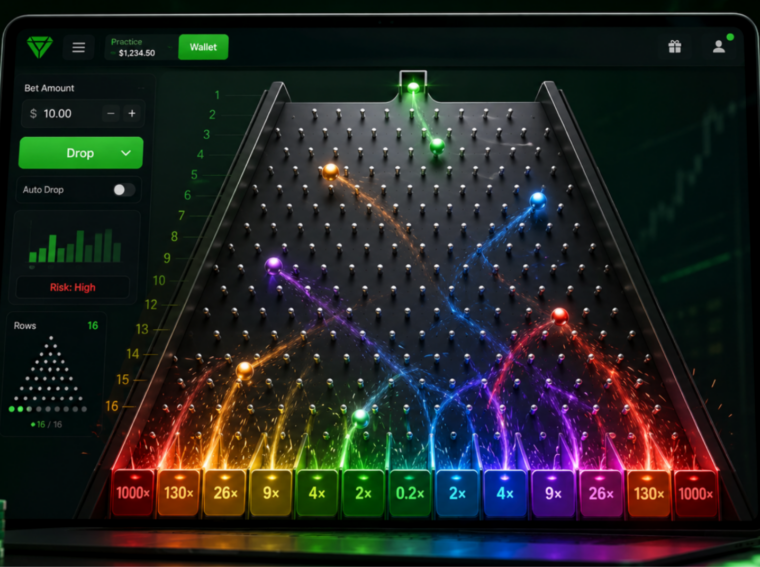
Row count is the setting that changes Plinko the most. Change the colors, theme, or pace, and the game still feels familiar. Add more rows, and the whole drop changes shape. The path gets longer. The result stays open for longer. Small bounces have more time to matter. On a 16-row board, that shift becomes obvious.
Portable play rewards games that are easy to read on a small screen and quick to understand from the first second. A 16-row board does not need extra systems to feel bigger. The row count does the work on its own. It turns a short visual event into something with more pace, more spread, and more suspense, while still staying simple enough to follow on a phone.
The key point is that a taller board does not only look taller. It changes the math, the pacing, and the way the result feels from the top peg to the last slot.
How row count changes the path
Each extra row adds one more left or right choice. That sounds small, but repeated choices build fast. After n rows, a chip has (2^n) possible path sequences. The number of landing slots only grows to n + 1, so many different paths collapse into the same slot. That is why the center fills more often than the edges. Many routes lead there. Very few routes reach the far ends.
The jump from 12 rows to 16 rows shows why this matters. A 12-row board has 4,096 possible path sequences. A 16-row board has 65,536. That is four extra rows and sixteen times more possible paths. The board still looks simple, but the fall has far more room to develop.
In this sense, plinko games online get their real shape digital players are familiar with. The center still matters most, because it remains the single most likely landing area. The edges still stay rare. What changes is the space between them.
On a taller board, the chip has more chances to drift away from the center and more chances to drift back. That makes the lower half of the board feel more alive. A path that looks settled halfway down can still move one or two slots before the finish.

This screenshot shows an 8-line setup. That means the chip makes fewer left-or-right choices before it lands. Because of that, the drop ends faster, and most results stay closer to the middle slots. In online plinko, this is the key difference from taller boards. When you add more rows, the chip has more time to drift, move back, and finish in a wider range of slots.
Sixteen rows also change pacing. On a short board, the result forms quickly. On a taller board, the drop unfolds in stages. The top rows set direction. The middle rows widen the spread. The lower rows decide whether the chip holds its line or swings again. That gives the fall a stronger arc.
The rule stays the same, but it runs longer
The numbers behind that feeling are clean. On a standard even-chance model, the spread of the result grows with the square root of the row count. In simple terms, more rows mean a wider finish. That is why plinko games feel calmer on shorter boards and wilder on taller ones.
The board is not changing its basic rule. It is letting that rule run for longer. At 16 rows, the change is big enough to feel right away, but still easy to follow on screen.
Why 16 rows fits modern play
The best way to see the shift is to compare a few board heights side by side.

This table explains the feel of a 16-row board better than any theme or animation can. The center is still the most likely single slot, but it controls less of the board than it did at 8 or 12 rows. At the same time, the total path count rises so sharply that each drop feels less compressed. There is more room for variation, and that variation is visible.
This recent market report says the global games market reached $188.8 billion and 3.6 billion players. Sensor Tower also reports that mobile gaming sessions rose 12% in 2024, while time spent rose 7.9% year over year.
So, modern gaming is built around short, repeatable sessions. A 16-row board fits that style. Players can understand it in a few seconds, but each round still has enough movement to feel different.
When a taller board starts to feel like a different game
There is also a deeper reason the 16-row board feels bigger than it looks. As rows increase, the chip’s final spread starts to show the classic bell-shaped pattern more clearly. That is the visual backbone of Plinko. Most results gather near the middle, fewer land farther out, and the whole board reads as a smooth curve made from many tiny decisions.

The math behind Plinko is simple: each new row creates more possible left-or-right paths. Those path counts follow Pascal’s triangle. That means most drops still land near the center, while the full spread gets wider as the number of rows increases. That is why a 16-row board feels wilder than a shorter board. The chip has many more possible routes before it finally lands.
A 2025 Scientific Reports paper by Gennaro Auricchio and colleagues states, “by increasing the number of peg rows and reducing the space between each peg, we get a closer approximation of the expected Gaussian distribution.” The same paper also notes that, in the standard model, variance is equal to the number of rows. That means a 16-row board has 33% more variance than a 12-row board. So the board is not only taller. Its result spread is materially wider.
More rows create more visible phases in the drop
That wider spread changes what the player sees during the fall. The first part of the drop gives a rough direction, but the lower part still has enough room to reshape the finish. On a shorter board, those moments blur together. On a 16-row board, they read as separate phases. That gives the drop more structure and more tension.
This is why 16 rows feel like a threshold. Below that point, the board often feels brisk and compact. At 16 rows, the same simple rule produces a fuller arc. The chip still moves peg by peg. The viewer simply has more time to feel the pattern forming.