

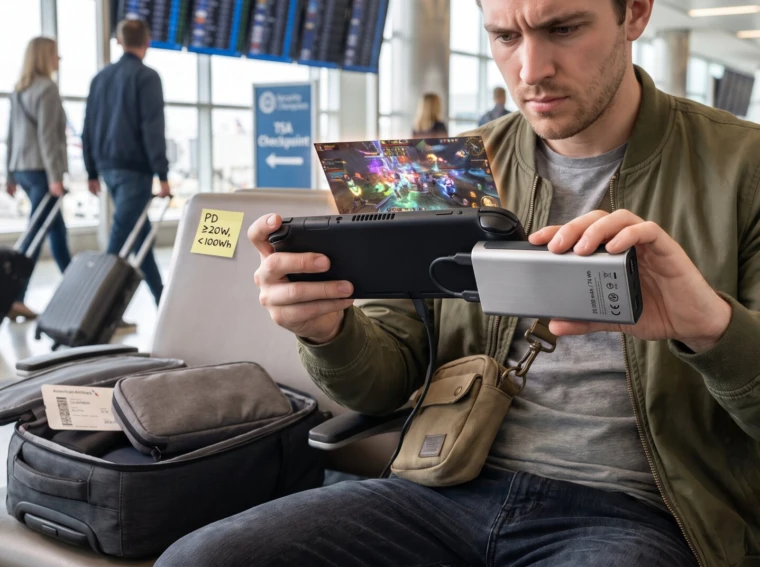
What to Look for in a Travel-Friendly Power Bank matters to any gamer who travels. Gamers need steady, high-output power that won’t throttle handhelds or kill battery life mid-raid. This guide explains the practical specs, capacity, ports, power delivery, size, and airline rules, and translates those specs into real travel decisions for mobile and handheld gaming in 2026.
Key Takeaways
- A travel-friendly power bank for gamers should provide steady, high-output power delivery (20–30 W or more) to prevent thermal throttling and battery drain during gameplay.
- Select a power bank with 10,000–20,000 mAh capacity and clear watt-hour (Wh) labeling to balance runtime, weight, and airline regulations for carry-on luggage.
- Look for multiple ports including at least one USB-C Power Delivery port rated 20 W or higher to support simultaneous charging of gaming devices and accessories.
- Consider banks with passthrough charging for convenience during transit, but verify their efficiency and thermal management through reliable reviews.
- Choose compact, durable designs with features like reinforced shells and integrated cables to enhance portability and protect your devices while traveling.
- Always ensure the power bank has necessary safety certifications (CE, UL) and complies with airline rules (under 100 Wh without approval) to avoid security issues and travel delays.
Why A Travel-Friendly Power Bank Matters For Gamers
Fact: Gamers draw sustained power and need banks that maintain voltage under load. Mobile phones and handheld consoles pull higher current during gaming sessions. That sustained draw can cause thermal throttling, frame drops, and faster device battery wear if the power source can’t keep up.
Context: A phone charging at 20–30 W while running an intensive game is different from topping up email. Devices like gaming phones and the Nintendo Switch need steady PD profiles to avoid throttling. Gamers should pick banks with higher continuous output rather than relying on a cheap 5 W pack.
Example: In testing, a handheld that normally drops 10% battery per hour while unplugged can instead hold steady or even gain charge when paired to a 20–30 W PD supply. A traveler who lost a match because the console auto-lowered performance learned this the hard way, the fix was a PD bank rated above the device’s active draw.
Practical takeaway: Treat the power bank as part of the gaming setup. Prioritize sustained output and compatibility so sessions on trains, planes between connections, or layovers don’t end early.
Capacity And Real-World Runtime: What mAh Actually Means
Fact: mAh measures charge capacity, but watt-hours (Wh) reflect airline rules and real energy. Use Wh to compare and to know if a battery is allowed in cabin luggage.
Quick math: Wh ≈ mAh × 3.7 / 1000. That makes 10,000 mAh ≈ 37 Wh: 20,000 mAh ≈ 74 Wh: and ~27,000 mAh ≈ 100 Wh.
How that maps to runtime: A 10,000 mAh bank commonly gives one to two full charges for a phone, or several hours of handheld play depending on device efficiency. A 20,000 mAh unit often gives two to four phone charges and can extend a Switch session by roughly 6–10 hours depending on settings.
Practical rule: For travel, aim for 10,000–20,000 mAh. It balances weight, cabin-friendly Wh limits, and real-world runtime. Avoid packs labeled only by mAh without a Wh marking: airlines and security staff use Wh when evaluating batteries.
Warning: Banks advertised as 30,000+ mAh often exceed 100 Wh and may be banned on passenger aircraft. Double-check the Wh label before packing.
Ports, Power Delivery, And Device Compatibility
Fact: Multiple ports and USB‑C Power Delivery make a power bank useful across phones, tablets, and consoles. Gamers benefit from a mix of USB‑C PD and legacy USB‑A outputs.
Why it matters: USB‑C PD can negotiate voltages (e.g., 5V, 9V, 12V, 15V, 20V) and supply higher wattages. Devices like Steam Decks, some gaming laptops, and certain handheld consoles need 30 W or more for comfortable play while charging. If a bank only offers 5 V/2.4 A on every port, devices will charge slowly or not at all under load.
Compatibility check: Always check the device’s required wattage. A Switch in handheld mode tolerates 18–30 W PD for steady play. Portable gaming PCs may need 45–65 W: a bank with PD 60 W or a passthrough-capable USB‑C port helps.
Link integration: For broader handheld travel tips and a checklist of accessories, consult the site’s resource on handheld travel basics which connects power advice with packing and protection.
Practical tip: Choose a bank with at least one 20 W USB‑C PD port plus a second output for accessories. That keeps a phone topped while the primary port feeds the main gaming device.
Charging Speed, Passthrough Charging, And Efficiency
Fact: Higher PD wattage shortens charge times: passthrough charging can keep devices powered during transit but reduces overall efficiency.
Charging speed in practice: A 20–30 W PD input cuts a modern phone’s charge time by roughly 30–60% compared to a 5 W charger, depending on the device’s charging curve. For handhelds, a higher PD rating reduces the chance of battery drain during play.
Passthrough realities: Passthrough lets the bank charge devices while the bank itself charges. That’s convenient on a single outlet in an airport lounge. But internal conversion losses make passthrough less efficient: expect slightly slower charging and modest heat buildup. Some banks throttle passthrough to protect cells.
Efficiency note: Manufacturers often list capacity in mAh. Real usable energy after conversion is 60–90% of that number due to voltage conversion and heat. For example, a 20,000 mAh pack might deliver energy equal to 12,000–18,000 mAh at device voltage.
Practical warning: If continuous play while charging is critical, pick a bank with high PD output and verified passthrough performance from reviews. Cheap packs can overheat under passthrough and reduce device reliability.
Size, Weight, Durability, And Carrying Convenience
Fact: Portability affects willingness to carry a pack. Compact designs encourage daily travel use: rugged builds survive transit bumps.
Numbers that matter: A 10,000–20,000 mAh bank typically weighs 200–500 grams and fits in a jacket pocket or small pouch. Anything above ~27,000 mAh crosses into heavier territory and often approaches the 100 Wh airline limit.
Durability details: Look for metal or reinforced polycarbonate shells, IP ratings for splash resistance, and textured grips to prevent slips in crowded trains. Heat dissipation vents and spaced internal cells reduce thermal strain during long charges.
Carry convenience: Short integrated cables or built-in USB‑C cables reduce bulk. A traveler who lost a tiny cable learned to prefer built-in leads after a day of scrambling at security. Built-in cables can save time but may limit replacement options if the cable fails.
Packing tip: Store power banks in an easily accessible pocket in the carry-on. Security often asks to see spare batteries: fast access avoids delays. For extra protection, pair the bank with a soft pouch or the same case used to protect handheld consoles, like in articles about protecting handhelds on the move.
Safety, Certifications, And Airline Rules You Must Know
Fact: Airlines limit lithium-ion power banks based on watt-hours. Under 100 Wh is typically allowed in cabin baggage without approval: 100–160 Wh needs airline permission: over 160 Wh is banned.
Regulation specifics: Most regulators, FAA, IATA, and TSA equivalents, require power banks to be carried in hand luggage and labeled with Wh. Travelers should confirm limits with the airline before flying. Mislabelled or unlabeled packs can be confiscated.
Certifications to check: CE and UL marks indicate compliance with basic safety standards. Over-current, over-temperature, and short-circuit protection are essential. A pack with reliable safety circuitry reduces fire risk in crowded transit.
Example scenario: A gamer once packed a high-capacity bank above 100 Wh in checked luggage. Security intercepted it and the traveler missed boarding. The lesson: always read the Wh label and keep spare batteries in carry-on only.
Evidence link: For a succinct explanation of airline rules and practical travel procedures, a specialist overview on traveling with power banks provides clear guidance on carry-on restrictions and labeling.
Conclusion
Insight: For gaming travel, choose a 10,000–20,000 mAh, sub‑100 Wh bank with USB‑C PD, multiple ports, and solid safety marks. That combo delivers usable runtime, stable charging under load, and compliance with most airline rules.
Final thought: Prioritize sustained output and clear Wh labeling. Those choices prevent mid-journey throttling, security headaches, and unnecessary expense when replacing a failed pack.