

ThePortableGamer Guides: A Complete Resource for Handheld, Mobile, and Travel Gaming opens the door to portable play that fits workdays, commutes, and vacations. It explains why handheld, mobile, and travel gaming matter now, and it helps readers pick devices, build a library, and optimize for trips. The guide uses market data and practical experience to show which specs matter, what accessories reliably extend playtime, and how to avoid common packing mistakes. Readers who want confident buying and packing choices find focused, actionable steps here.
Key Takeaways
- ThePortableGamer guides emphasize that handheld gaming unlocks quality play during commutes and travel without sacrificing game depth.
- Choosing the right handheld gaming device requires balancing portability, battery life, and game library access to fit your play style.
- Prioritize chipset performance, display quality, memory, battery capacity, and cooling for a smooth portable gaming experience.
- Build a versatile portable game library by mixing quick-play titles with longer narratives and using cross-save features to sync progress.
- Optimize travel gaming by managing battery through lower refresh rates, carrying a high-capacity power bank, and packing compact, useful accessories.
- Strong connectivity via 5G or Wi-Fi and offline preparation are essential to maintain seamless gaming on the go.
Why Handheld, Mobile, And Travel Gaming Deserve A Place In Your Routine
Fact first: handheld, mobile, and travel gaming unlocks meaningful playtime during dead moments, commutes, flights, and waiting rooms, without sacrificing big‑game experiences. Modern handhelds use semi‑custom AMD APUs or high‑end phone chipsets that close the performance gap with laptops, so a thirty‑minute session can feel polished rather than disposable.
ThePortableGamer Guides highlight hard numbers: combined mobile and handheld spending is projected above $200 billion by 2029, and PC‑style handheld sales are rising toward millions of units by mid‑decade. For players, that means more first‑party support, frequent firmware updates, and ecosystems optimized for save syncing.
Practical takeaway: slot portable play into a routine by assigning types of sessions. Use short, focused mobile runs for social or turn‑based play and reserve console‑style handheld sessions for narrative or competitive titles. The approach prevents burnout and makes travel time into consistent leisure. This section connects market shifts to everyday habits and shows how small changes, turning off auto‑sync, lowering refresh rate by 30–60Hz, extend usable battery life during a trip.
Choosing The Right Device: Handheld Consoles, Phones, And Cloud Options
Answer: match device class to how and where they play most. Handheld consoles and PC handhelds suit controller‑first AAA and indie ports: phones excel at social and touch games: cloud gaming suits light carry and vast libraries.
Handheld consoles (including Steam Deck‑class devices) provide physical controls and native performance for large titles. Phones offer instant access and cellular connectivity, with top 2026 models using Snapdragon 8 Elite equivalents, 120–165Hz OLED panels, and 5,000mAh+ batteries. Cloud options reduce local storage needs and let players stream big libraries over 5G or strong Wi‑Fi.
When choosing, readers should balance three constraints: weight/size for travel, battery capacity for session length, and library access. ThePortableGamer Guides recommend testing ergonomics in store where possible and comparing boot/load times for typical games. For deeper device selection steps and comparisons, the pillar guide outlines hands‑on checks and buying criteria in a device checklist that helps readers choose confidently: handheld gaming.
Key Specs And Features To Prioritize For Portable Play
Fact: prioritize chipset, display, memory, battery, and cooling in that order for consistent portable performance.
Chipset: top handheld phones in 2026 use Snapdragon 8 Gen 3 or 8 Elite equivalents: PC handhelds rely on semi‑custom APUs to run PC ports. Display: favor 120Hz+ AMOLED/OLED with high touch sampling for responsiveness, many gaming phones hit 165Hz. RAM/storage: aim for at least 8GB RAM and 256GB storage to avoid slowdowns and frequent installs. Battery/charging: look for 5,000–6,000mAh cells with fast charging (65–80W common) to restore large batteries during short layovers.
Cooling and ergonomics directly affect session length. Devices with better thermal management sustain higher clocks and avoid throttling: that yields measurable frame rate stability. For curated comparisons and hands‑on testing of leading handhelds, readers can reference a recent roundup that benchmarks portability and performance: handheld PC roundup.
Building A Portable Game Library: Picks, Platforms, And Storage Strategies
Direct insight: build a library that balances quick‑play hits and long narrative titles while prioritizing cross‑save and low install friction. Mobile and handheld AAA ports often reach 10–20GB: plan storage around that.
Platform choices matter. Use first‑party stores, Nintendo eShop, Steam, Google Play, Apple App Store, for vetted titles and reliable cloud saves. Cross‑progression keeps home progress intact when shifting between a console and a handheld: prioritize games that support that feature. For example, action RPGs with 15GB installs require different planning than 200MB puzzle games.
Storage tactics: keep a rotating install list. Archive large titles to external or expandable storage when possible, and keep essential quick‑play games local. ThePortableGamer Guides recommend maintaining at least 30–40% free space to reduce install times and avoid OS slowdowns. For practical prep before a trip, readers can follow a step‑by‑step checklist to prepare titles for offline play: prepare games for offline play.
Optimizing For Travel: Battery, Accessories, Connectivity, And Packing Tips
Answer up front: optimize devices for travel by treating battery and connectivity as primary constraints, then choose compact accessories that add high value per ounce.
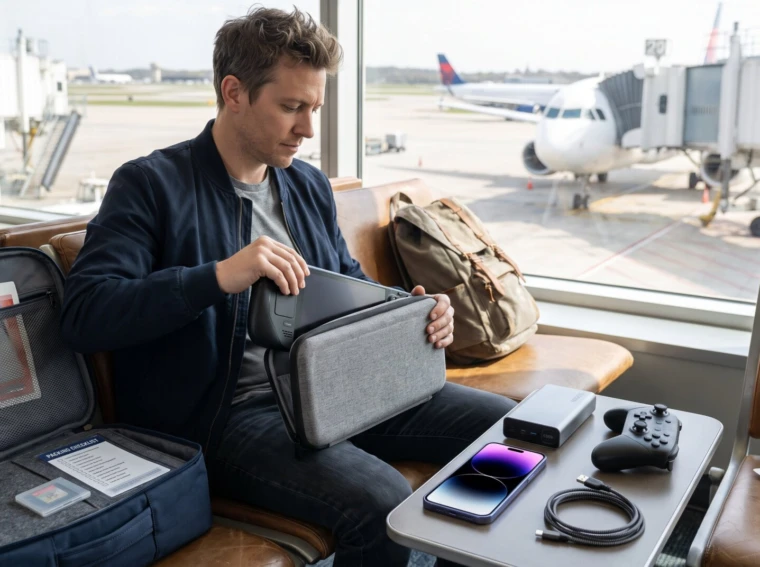
Battery: select devices with 5,000–6,000mAh cells and lower refresh rates during flights to extend runtime. Carry a 20,000mAh power bank (ideally 45–65W PD) to recharge quickly between sessions. Accessories: pack a compact controller, USB‑C cable, a low‑profile case, and a thin screen protector. Small items, like a 200‑gram travel controller, often deliver the biggest comfort gain for their weight.
Connectivity: prefer dual‑band/tri‑band Wi‑Fi and 5G for cloud gaming and mid‑trip downloads. When relying on public Wi‑Fi, use saved offline maps and predownloaded game updates. For device protection and incident prevention, readers should follow focused handling tips and case choices, this guide includes practical measures to protect portable hardware in transit: protect a handheld. For empirical battery life comparisons, benchmark testing from a trusted outlet clarifies realistic runtimes under load: battery life testing.
Conclusion
Insight: handheld, mobile, and travel gaming now deliver reliable, high‑quality play if players match device class to use, prioritize key specs, and adopt travel‑focused routines. ThePortableGamer Guides frame those choices with hands‑on checks, storage plans, and packing lists so players spend more time playing and less time troubleshooting on the road.