

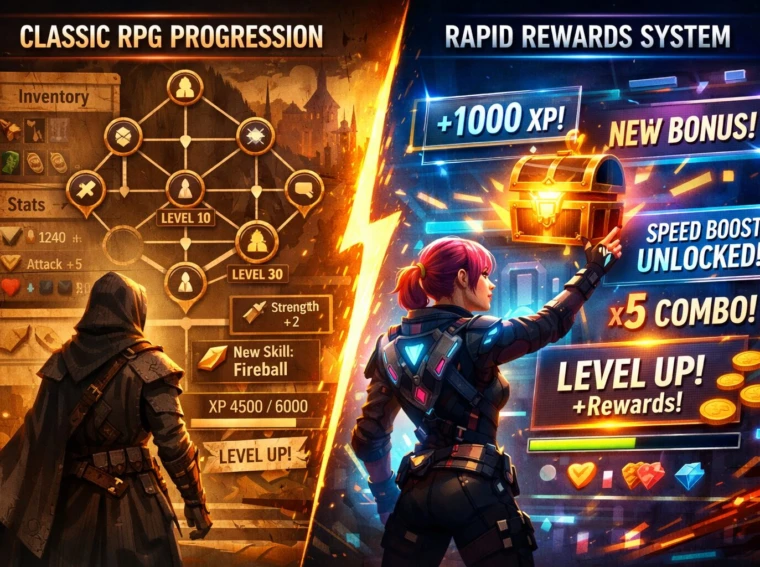
Player behavior is clearly shifting dramatically in the world of game progression, with retention data highlighting a preference for instant feedback loops. This article explores why rapid rewards are capturing attention and really reshaping RPG design.
For years, lots of traditional role-playing games (RPGs) relied on deep progression systems: slow leveling, rich narratives and long-term goals that rewarded patience. However, recent player surveys and retention statistics suggest a growing appetite for games that deliver near-instant gratification and short session rewards. This trend certainly isn’t just anecdotal; it’s backed by hard data from both player behavior and industry research.
What Retention Metrics Reveal About Modern Player Engagement
Modern analytics platforms allow developers to track player behavior with unprecedented detail. Key metrics, such as daily active users (DAU), session length, churn rate and lifetime value, paint a clear picture: players stay engaged longer when they receive frequent, positive in-game feedback.
Retention curves in many titles now resemble a steep dropoff after the first session, followed by a plateau among players who engage with short, satisfying reward loops rather than slow grind mechanics. This is particularly visible in mobile and live-service games, but the trend has crossed over into PC and console RPGs as well.
Consider games that offer incremental rewards for short blocks of playtime versus those that require hours of exploration before a meaningful payout. The former consistently achieves higher 7-day and 30-day retention rates, indicating that players return when they feel progress with each play session.
How Instant Feedback Impacts Session Length and Return Rates
Retention analytics reveal that instant feedback loops significantly influence both session duration and return frequency. Players are more likely to engage in multiple short sessions throughout the day rather than a single long marathon. This pattern aligns with broader digital behavior trends, where users expect on-demand satisfaction across platforms.
Games designed to reward players for completing bite-sized goals, like finishing a quest, defeating a minor boss, or hitting a milestone within a level, see higher rates of daily return. This effect was visible in several recent titles that revamped their progression mechanics to include more immediate milestones.
In contrast, games that stick rigidly to sprawling progression models without offering quick wins often see higher churn rates after the first few hours. Players who feel progress is too slow or unclear may disengage entirely, even if they initially invested time and emotional energy into the story or world.
Comparing Long-Term Grind Systems With Short-Cycle Reward Loops
Traditional RPG progression systems often emphasize experience points, elaborate skill trees, and narrative milestones. These deep progression elements create a sense of long-term investment but can also lead to frustration or fatigue if progress feels too slow or opaque.
By contrast, games that harness short-cycle reward loops provide immediate feedback for player actions. These loops might include small level-ups, loot drops, quick quests, or in-game events that reward daily participation. The psychological satisfaction of frequent reinforcement keeps players coming back on a daily rhythm, which in turn boosts long-term engagement metrics.
Outside traditional RPGs, short-cycle reward systems also appear in chance-based digital formats designed for brief sessions and rapid outcomes. Progressive jackpot slots rated by feedback platforms illustrate this structure clearly, with comparisons focusing on how frequent resolution and visible reward events influence repeat engagement.
This comparison underscores a larger point: players often prefer systems where effort quickly translates to reward; not just for the dopamine hit, but because clear feedback loops help them understand the game’s value proposition sooner.
Player Survey Insights on Motivation, Progress and Satisfaction
Quantitative data must be paired with qualitative insights to fully understand player motivations. Surveys consistently reveal nuanced preferences: while players appreciate rich lore and deep customization, they also want to feel rewarded frequently.
The 2023 Mobile Gaming Loyalty Report found that a lack of progression is a primary reason players churn: over 54 % of players quit games when they feel advancement stalls, while nearly 57 % name the desire to meet milestones as a core motivator to stay engaged (forbes.com, 2025) .
Player sentiment often highlights frustration with steep leveling curves or mechanics that require repetitive grinding without sufficient reward. Conversely, rapid reward systems, even those that sit alongside complex mechanics, are praised for keeping players engaged and focused on the next objective. Importantly, these preferences don’t signal the death of classic RPG elements, but rather an appetite for hybrid systems that balance depth with responsiveness.
Why Data-Driven Design is Reshaping RPG Progression Models
The shift toward rapid reward systems is not merely anecdotal; it’s a response to data. Retention dashboards, cohort analysis and predictive modeling give studios the tools to iterate on progression mechanics that resonate best with their audience. Publishers are increasingly A/B testing progression features to find the optimal mix of depth and immediacy.
Today’s designers are learning that rewarding players frequently, even in small ways, keeps them more emotionally invested, increases session frequency and improves long-term engagement metrics. As a result, classic RPG titles are evolving to incorporate dynamic quest rewards, mini-achievements and feedback systems that celebrate incremental progress.
This doesn’t mean abandoning story or complexity, but rather enhancing them with systems that acknowledge modern expectations. In an era where digital consumers are accustomed to instant responses, from social media likes to real-time notifications, games that embrace rapid feedback loops are better positioned to build loyal, long-term audiences.